There's a particular kind of panic that sets in around late September, when you realise…
What 18,000 Event Staff Bookings Really Taught Us About Reliability
And why clients aren’t really buying staff at all
When people talk about successful events, the conversation almost always begins in the same place. Attention is drawn to the visual elements, the design of the stand, the strength of the branding, the number of visitors who attended, and the level of engagement achieved throughout the day. These are, of course, important measures, and they form the basis of most post-event reports.
However, when you spend a significant amount of time working behind the scenes in the events industry, a different picture begins to emerge. The true success of an event is rarely determined by what is most visible. Instead, it is shaped by something much quieter but far more influential: the consistency and reliability of the people delivering it.
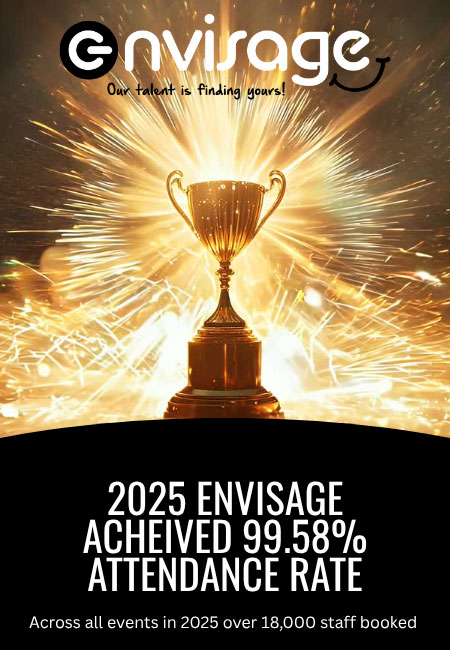
At Envisage Promotions, this has become increasingly clear through experience. During 2025, we supported more than 18,000 staff bookings across the UK, covering exhibitions, retail activations, brand experiences and large-scale seasonal events. Looking back across that volume of work, the most valuable insight is not tied to any single campaign or client. It is the recognition that reliability is not simply a desirable quality, but a defining factor in how an event unfolds.
It Rarely Starts as a Conversation About Reliability
Most clients do not begin by asking about attendance rates or staffing processes. Typically, the initial conversation is practical and straightforward. They need a certain number of staff, for specific dates, in particular locations. The request is framed in terms of logistics, availability and roles.
Yet beneath that practical request sits something more important, even if it is not always expressed directly. Clients are not simply looking for people to fill positions; they are looking for reassurance that the event will run smoothly. There is an underlying concern about whether everything will come together as planned, whether the team will perform as expected, and whether they themselves will be able to focus on the event rather than managing problems.
In that sense, the service being requested is not just staffing. It is certainty.
Looking Beyond the Task: What Clients Are Really Buying
There is a well-established idea in business that customers do not buy products for their own sake, but for the outcome those products enable. A person does not buy a drill because they want a drill; they buy it because they want to put up a shelf. The tool is simply the means to an end.
The same principle applies to event staffing. Clients may request a number of staff, but what they are really seeking is the end result those individuals help to create. They want a stand that feels active and welcoming, a team that engages naturally with visitors, and an environment that reflects positively on their brand.
Perhaps most importantly, they want to feel confident that everything is under control. That sense of calm and assurance is what allows them to focus on the purpose of the event, rather than being drawn into operational concerns.
What the Data Tells Us About Reliability
When working at scale, patterns begin to reveal themselves in a way that is difficult to ignore. Across the 18,000 bookings we fulfilled in 2025, one figure stands out as particularly significant: a 99.58% attendance rate.
On paper, it may appear to be just another performance metric. In practice, it represents something much more meaningful. It reflects the number of times an event began exactly as planned, with the right people in the right place, ready to deliver. It also reflects the absence of disruption the situations that did not occur, the issues that did not escalate, and the problems that never reached the client.
This is where reliability moves beyond statistics and becomes part of the overall event experience.
The Impact of Unreliable Staffing
To fully understand the value of reliability, it is helpful to consider what happens when it is lacking.
When staffing is not dependable, the effect on an event is rarely dramatic at first, but it is immediately noticeable. The day may begin with a small imbalance, perhaps caused by someone arriving late or not at all. This in turn requires others to adjust, stretching their responsibilities and dividing their attention. What should have been a well-structured team effort becomes something more reactive, as individuals compensate for gaps rather than focusing on their intended roles.
As the day progresses, these small disruptions can accumulate. The client may find themselves checking in more frequently, responding to issues rather than leading the event, and diverting attention away from visitors and objectives. Even when the situation is managed effectively, the overall experience feels more pressured than it should.
What tends to stay with the client afterwards is not necessarily the detail of what went wrong, but the sense that the day required more effort, more intervention and more concern than expected. That feeling can shape how they view the success of the event as a whole.
The Wider UK Context
In the broader UK workforce, absence rates typically range between two and four percent, depending on the sector and time of year. In many environments, this level of absence can be absorbed without significant disruption. Tasks can be redistributed, deadlines adjusted, and teams can adapt over time.
Events operate very differently. They are live, time-sensitive and often highly visible. When a member of staff is not present, the impact is immediate and cannot be easily concealed. There is no opportunity to revisit the moment or recover the lost interaction.
For this reason, even relatively small differences in attendance rates can have a considerable effect on how an event runs. A higher level of reliability does not simply improve efficiency; it fundamentally changes the experience for everyone involved.
How Reliability Is Actually Achieved
It would be easy to assume that strong attendance rates are simply the result of having capable individuals. While the quality of staff is undeniably important, reliability is rarely the result of chance. It is the outcome of a structured and consistent approach.
This begins with selecting the right people for each role, taking into account not only their experience but also their suitability for the specific event. It continues with clear and thorough briefing, ensuring that expectations are understood well in advance. Communication plays a crucial role throughout, with regular contact leading up to the event helping to reinforce commitment and clarity.
In addition, effective planning always includes contingency measures. Even with the most reliable systems, unexpected situations can arise. The key difference lies in how these situations are managed, and whether they are resolved quietly in the background or become visible issues on the day.
Timing and Demand Across the Year
Another important factor that becomes evident through experience is the seasonal nature of demand. The UK events calendar follows a relatively consistent pattern, with peaks occurring in spring, summer, early autumn and the Christmas period.
During these times, demand for experienced staff increases significantly. While this is not surprising, what is often underestimated is how early those individuals are secured. Leaving staffing arrangements until the final stages of planning can limit both availability and choice, making it more difficult to assemble a strong and reliable team.
Approaching staffing as an early priority, rather than a final task, allows for better selection, stronger preparation and ultimately a smoother event.
What Clients Remember Most
After an event has concluded, performance is often reviewed through data and reporting. Metrics such as footfall, engagement and conversion rates provide valuable insight into outcomes.
However, when clients reflect on the experience itself, their memories tend to focus on something less tangible. They recall whether the day felt organised, whether the team worked cohesively, and whether they were able to concentrate on their objectives without distraction.
These impressions are shaped not by isolated moments, but by the overall flow of the event. In many cases, that flow is directly influenced by the reliability of the people delivering it.
The Role of Envisage Promotions
At Envisage Promotions, our involvement extends beyond supplying staff to meet a requirement. Our role is to contribute to the overall delivery of the event, ensuring that the experience aligns with the client’s expectations from start to finish.
This is achieved through careful preparation, thoughtful matching of staff to roles, and consistent communication throughout the process. While much of this work takes place before the event begins, its impact is most visible on the day itself, when everything comes together as planned.
When an event runs smoothly, it is often because the groundwork has been handled effectively in advance.
Looking Beyond the Numbers
It is easy to view staffing as a practical necessity, something to organise alongside other logistical elements of an event. However, as experience and data both demonstrate, it plays a far more significant role.
Reliability influences not only how an event operates, but how it is experienced and remembered. It determines whether the day feels controlled or uncertain, whether the client can focus on their goals or becomes absorbed in managing issues.
For this reason, it is worth approaching staffing with a slightly different perspective. Rather than focusing solely on numbers, it is helpful to consider the outcome you want to achieve.
Not simply how many people are required, but how you want the event to feel.
Because in the end, that is what makes the lasting difference.
Related Posts