There's a particular kind of panic that sets in around late September, when you realise…
How to Maintain Consistent Visitor Experience Across a Long-Running Exhibition
In short, consistency at a long-running exhibition comes from documenting the standard properly, onboarding every new or replacement team member against it, and checking that it’s holding once the exhibition is actually live. It doesn’t happen by itself, and it doesn’t happen just because the opening week went well. A short activation can often coast on energy and a strong initial briefing. A long-running exhibition, open for months rather than days, cannot. The gap between a confident opening week and a flat final week is one of the more common and most preventable problems in exhibition staffing.
This article sets out what tends to erode consistency over the long run, and the practical steps that keep the visitor experience steady from the first day through to the last.
What Counts as a Long Run?
There’s no fixed cut-off point, but the challenges in this article tend to start appearing once an exhibition runs well beyond a few weeks, particularly once the original opening team is no longer the only team on the floor. A three-day trade show rarely needs much of this process, because the same small group who were briefed together are usually still there when the doors close. A run of several months is a different proposition entirely. By the halfway point, it’s common for a meaningful share of the floor team to be people who weren’t in the room for the original briefing at all.
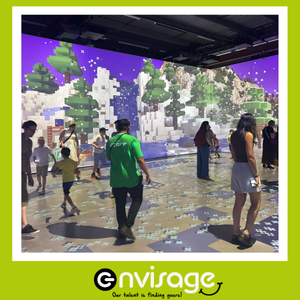
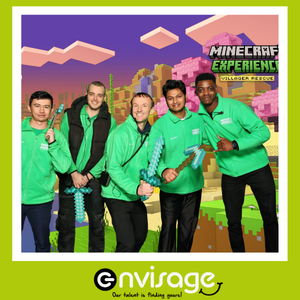
Envisage’s own experience on Minecraft: Villager Rescue at Canada Water, London, is a useful reference point for scale. Across the full run of that immersive exhibition, our teams delivered 69,887 staffing hours and 6,497 completed shifts, at a 99.45% attendance rate. A project of that size makes the point clearly: with thousands of shifts to fill, even a small dip in consistency early on has room to compound across the run in a way it simply couldn’t on a shorter booking.
Why Consistency Gets Harder the Longer an Exhibition Runs
A short event has one natural advantage. The same people briefed on day one are usually still on the floor on the final day. A long run doesn’t have that advantage built in.
Over several months, a few things happen at once. Staff rotate, illness, or simple availability. The team members who sat in on the original briefing gradually became a smaller share of the people actually on shift. Repetition sets in, too. Explaining the same interactive moment for the two-hundredth time takes a different kind of energy to sustain than the first. And without anyone intending it, small interpretations of the brief start to shift, day by day, until the visitor experience near the end of the run only loosely resembles the one that was signed off at the start.
None of this points to a badly run exhibition. It’s simply what happens to any experience delivered by people, repeated at scale, over time, unless something is actively done to counter it.
What Consistent Actually Means for a Visitor
Consistency doesn’t mean every visitor gets an identical, scripted interaction. It means the standard of experience, the energy, accuracy, and quality of engagement doesn’t depend on which day someone happened to visit or which staff member they happened to meet.
On an interactive exhibition like Minecraft: Villager Rescue, that mattered from the moment a family arrived. Front desk and ticket scanning staff set the tone for the whole visit, so the experience needed to feel just as quick and welcoming during a busy half-term afternoon as on a quiet Tuesday morning. Through the gallery spaces, that same standard needed to hold too, with staff sustaining energy and enthusiasm across a full day of repeat groups, not just for the first few visitors of the shift.
It’s worth being specific about the difference between consistency and uniformity. Two staff members can deliver the same moment in genuinely different ways, one more animated, one more measured, and both still meet the standard, provided the accuracy and quality of the interaction are equally strong. The goal isn’t to make every staff member interchangeable. It’s to make sure the visitor’s experience doesn’t come down to luck.
The Main Threats to Consistency Over a Long Run
Staff rotation and turnover. Every new team member who joins partway through the run starts from a different position from the original team. They weren’t in the room for the original briefing, and without deliberate onboarding, they end up learning the role from whoever happens to be on shift with them.
Fatigue and repetition. Even staff who’ve been there since day one can find their energy dipping over the long run. The demonstration or interaction that felt fresh in week one is a different task, psychologically, by week fifteen.
Interpretation drift. Standards that only exist as a memory of the original briefing tend to shift gradually, shift by shift, without anyone consciously deciding to change anything.
Inconsistent supervision. On a long run, it’s common to have several different team leads covering different weeks or shift patterns. Without a shared reference point, each one can end up running the floor slightly differently from the last.
None of these threats tends to announce itself. They build slowly, which is exactly why they’re so often missed until a visitor complaint, a site visit, or a review of feedback shows that something has quietly changed since opening day.
How to Recognise Drift Before a Visitor Does
Because interpretation drift happens gradually, it’s rarely obvious from the inside. A team lead who has been on site since the start may not notice their own standard has shifted, simply because the change has been so incremental. A few signs are worth watching for specifically: visitor feedback scores dipping slowly rather than suddenly, new team members describing the brief slightly differently depending on who trained them, or a demonstration that has quietly picked up shortcuts nobody consciously introduced. Catching drift at this stage, before it’s visible to visitors, is far easier than correcting it once it’s become the new normal on the floor.
How to Build Consistency From the Start
The best way to protect consistency is before the exhibition opens, not partway through once drift has already set in.
Document the standard, not just the brief. A briefing delivered verbally on day one is only as strong as everyone’s memory of it three months later. A written reference, covering tone, key messaging, and what good actually looks like across each part of the visitor journey, gives every new or existing team member the same thing to be measured against.
Build onboarding for the length of the run, not a single day. A long-running exhibition needs a process that can be repeated for every replacement or additional team member who joins later, not a one-off induction designed for an opening-day team. On a project the size of Minecraft: Villager Rescue, with staff working across front desk, ticket scanning, photo points, gallery spaces, and retail, that meant onboarding had to work consistently across several distinct roles at once, not just one.
Plan refresher briefings into the schedule. Even the original team benefits from being brought back to the standard periodically, rather than assuming the opening-day briefing will hold, unchanged, for months.
Keeping It Consistent Once You’re Live
Building consistency at the start only holds if it’s actively maintained once the exhibition is running.
Regular spot checks. Someone, whether that’s a team lead, agency account manager, or client representative, needs to periodically check the floor against the documented standard, not simply trust that it’s holding.
A genuine feedback loop between shifts. Staff on the floor are usually the first to notice where a visitor experience is falling flat, whether that’s an interaction that isn’t landing or a question visitors keep asking that isn’t covered in the current brief. That feedback needs a clear route back to whoever owns the standard and clear evidence that it’s actually acted on.
A clear escalation path. When something isn’t working- a technical fault, a gap in the brief, a recurring visitor complaint- everyone on the floor should know exactly who to flag it to, rather than each shift handling it differently.
Regular reporting back to the client. On Minecraft: Villager Rescue, ongoing communication with the client allowed staffing levels to be adjusted in response to real visitor demand throughout the run, rather than being fixed once at the start and left unchecked. Even a brief, regular update on what’s working and what’s been flagged gives a client genuine visibility into how the standard is holding, without needing to be on site constantly themselves.
The Role of the Agency vs the Client
Maintaining consistency over the long run sits on the same divide covered by who’s responsible for training your interactive experience staff. The agency owns the professional standard and the mechanics of onboarding new team members correctly. The client owns the brand and content accuracy that the standard is measured against. On a long-running exhibition, that division doesn’t end once the doors open on day one. It needs to keep functioning for the full length of the run, which is usually where the real difference between agencies shows up, not in how well they brief an opening-day team, but in how well they maintain that standard on a partially rotated one, months later.
How Envisage Approaches This
On Minecraft: Villager Rescue, Envisage supplied staff across the full run of the exhibition, from front desk and ticket scanning through to gallery spaces and the on-site retail shop. With high daily footfall and long operating days built into an experience where visitors weren’t just observing but actively taking part in the story, the standard needed to hold whether a shift fell on a quiet weekday morning or the busiest school holiday afternoon.
Exhibition Staff were selected for enthusiasm and confidence as much as reliability, and trained to sustain energy and engagement across long operating days rather than just the first few hours of a shift. Across the run, that approach delivered 69,887 staffing hours and 6,497 shifts at a 99.45% attendance rate, meaning coverage never became a gap the client had to manage, and the visitor experience stayed just as engaging near the end of the run as it was on opening day.
A Quick Checklist for Long-Running Exhibitions
- Is the visitor experience standard written down, not just remembered from the original briefing?
- Does onboarding exist as a repeatable process for anyone joining after day one?
- Are refresher briefings scheduled in advance, not left to happen only if something goes wrong?
- Is someone actively checking the floor against the standard at intervals through the run?
- Is there a clear, known route for staff feedback and for escalating problems?
- Has ownership of the standard been agreed between agency and client for the full length of the run, not just the opening days?
Getting the Standard to Hold, Right to the Final Day
Consistency across a long-running exhibition isn’t the result of a strong opening brief on its own. It’s the result of documenting that brief properly, onboarding every new team member against it, and actively checking that it’s holding all the way through to the final day. Get that right, and a visitor near the end of the run gets the same standard of experience as one on opening night.
If you’re planning a long-running exhibition and want a staffing partner who can hold a standard for the full length of the run, see how Envisage approaches immersive and interactive event staffing. And if you haven’t already, what interactive event staffing actually involves and who’s responsible for training that staff are the two companion reads in this series.
Related Posts