What Is Interactive Event Staffing? (And Why It Requires a Different Kind of Person) In…
Staffing a Touring Exhibition Across Multiple UK Cities: What You Need to Plan For
Most touring exhibitions plan the installation in forensic detail. The staffing gets planned too, but rarely with the same rigour, and the gap between the two shows up in the visitor experience.
A venue change is not just a logistical event. It is a staffing reset. New building, new audience, new local labour market, and new operational pressures that no amount of experience from the previous city can fully predict. The questions that separate well-run touring exhibitions from underperforming ones are rarely about headcount. They are about knowledge depth, briefing consistency, rota resilience, and whether the agency behind the team has the infrastructure to hold a standard across cities and across time.
This article covers what you need to plan for before you appoint an agency, what changes between cities and what cannot be allowed to, why local staffing is almost always the right call and how to make it work in practice, and what the transition between venues demands that most clients do not anticipate until it is already happening.
Tutankhamun: The Exhibition That Shaped This Thinking
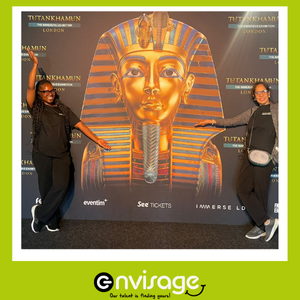
Envisage provided the full staff team for the Tutankhamun exhibition across both its London and Birmingham runs, covering every role from visitor hosts and tour guides through to crowd management and operations. In London, that meant 2,780 shifts and 30,481 staffing hours delivered at a 99.67% attendance rate. The Birmingham run, planned over 88 days from June to September 2026, accounts for over 900 shifts and more than 8,000 staffing hours. In both cities, every team member was sourced and trained locally.
The operational detail in this article comes directly from that experience. Not from theory, and not from a checklist built in a meeting room.
The Visitor Experience Has to Be Consistent. The Staffing Model Has to Be Adaptable.
These two things sound like they are in tension, they are not. Consistency in the visitor experience comes from a consistent framework: the same quality of subject knowledge, the same standard of engagement, the same tone and approach across every zone. But the way that framework is delivered has to flex around the realities of each venue.
A layout that creates natural visitor flow in one building may produce bottlenecks in another. A zone that needed two staff members in London may need three in Birmingham because the sight lines are different and the room holds more people. An entrance sequence that worked in one venue may not work in the next because the foyer is a different shape. None of this should require rebuilding the staffing model. It should require adapting it, which is only possible if the model was documented properly in the first place.
The operational documentation from the first city is one of the most undervalued assets a touring exhibition carries. Role descriptions, zone maps, briefing materials, escalation protocols, rota patterns, visitor flow notes: all of it should travel with the exhibition and be reviewed and adjusted for the next venue, not recreated from scratch by a team who were not there for the original run.
The Case for Local Staffing: Why Bringing a Team With You Is Rarely the Right Answer
There is a recurring temptation, particularly on exhibitions where the first city’s team has performed well, to bring that team to the next venue. The logic is understandable: known quantities, already briefed, already embedded in the experience. In practice, it introduces more risk than it removes.
Local staff know the city. They understand how audiences in that region typically behave at cultural events, what the likely visitor profile looks like, and how to navigate the practical geography of working in their own city. They are not arriving tired from a journey. Their availability is predictable in a way that a relocated team’s is not, particularly over several months where personal circumstances can change. And critically, they are invested in the work in a way that temporary relocation rarely replicates.
The argument against local staffing is usually framed as a quality concern: will a locally sourced team reach the same standard as the one that delivered the previous city? That is the right question. But the answer lies in the briefing process and the agency’s depth in that local market, not in where the person lives. A well-briefed local team will consistently outperform a displaced team managing the additional pressure of being away from home.
George Kelly, Envisage “Every city brings a different audience and a different venue, so touring exhibitions live or die on the quality of the local team behind them. We recruit and train locally in each city, because that local knowledge, of the venue, the transport links, and the audience, is what keeps attendance and guest experience consistent as a tour moves around the country. It’s not about parachuting staff in for a few weeks; it’s about building a team that’s genuinely invested in the run.”
Local Candidate Pools Are Not Uniform Across UK Cities
Choosing local staffing is the right decision. Assuming that the right local staff are equally available in every UK city is a different matter. The depth and character of the event staffing market varies significantly between cities, and cultural exhibition staffing in particular draws on a narrower subset of that market than general event work.
London has the largest and most varied pool of event and exhibition staff in the UK. Birmingham, Manchester, Edinburgh, and other major touring destinations all have active markets, but the concentration of people with specific experience in long-run immersive or cultural exhibition environments is smaller. That does not mean the right people are not there. It means finding them takes longer and requires more active sourcing than a database search will deliver.
For an exhibition like Tutankhamun, where staff are expected to hold detailed conversations about ancient Egyptian history, the specific narrative of Howard Carter’s discovery, and the significance of individual artefacts on display, the selection criteria go well beyond event experience. Subject matter aptitude, the ability to absorb and communicate complex historical content naturally, and genuine comfort with extended visitor dwell time are all requirements that narrow the pool considerably. An agency sourcing for Birmingham needs to understand that and build lead time accordingly.
The agencies that perform consistently across multi-city touring runs are those with genuinely active regional operations, not those with a London base and nominal national coverage. The difference becomes apparent not in the pitch meeting but on the first shift of a new city, when the quality of the team on the ground either confirms or undermines the planning that preceded it.
Briefing Is Not a Single Event. On a Touring Exhibition, It Is a System.
The briefing that happens before the first city opens is not the briefing that sustains quality across a full touring run. On a long-run exhibition, staff turn over. New people join mid-run. Knowledge that was current on day one becomes inconsistent by month three if there is no structured mechanism for maintaining it. When the exhibition then moves city, and a largely new team arrives, the briefing challenge resets entirely.
A briefing system, rather than a briefing event, means the content knowledge required to deliver the exhibition is documented, structured, and deliverable to new starters at any point in the run. For Tutankhamun, that meant staff needed to understand the archaeology and historiography of the discovery, the context of the artefacts, the narrative arc of the exhibition itself, and how to calibrate explanations for audiences ranging from primary school groups to adult enthusiasts with their own prior knowledge. Across 2,780 shifts in London alone, that standard had to hold from the first day of the run to the last.
The agencies that treat briefing as a logistics exercise produce teams that can manage a venue competently. They do not produce teams that can hold a detailed conversation with a visitor who arrived having read extensively about the subject. For cultural and immersive exhibitions, that gap is visible to every visitor who tries.
The briefing framework is the thing that travels with the exhibition. It should be reviewed and updated between cities, not rebuilt, and it should be the agency’s responsibility to deliver it consistently at every new venue.
The Transition Between Cities Is a Staffing Event in Its Own Right
The period between a run closing in one city and opening in the next is where multi-city touring exhibitions are most vulnerable. Attention is on the physical installation: derig, transport, rig, technical setup, opening night. The staffing transition receives less focus, and the consequences tend to appear in the first two weeks of the new city’s run.
A new team, in a new building, delivering a complex exhibition for the first time, without the benefit of the learning curve the previous city’s team accumulated over months, will have a settling-in period. That is unavoidable. What is avoidable is that period being unmanaged. The transition needs a clear plan: who is responsible for knowledge transfer, how the new team is brought into the exhibition before it opens to the public, what the rota looks like for opening days, and how performance is monitored in the early weeks.
For the Birmingham run of Tutankhamun, the planning timeline accounted for training dates within the 88-day operational window, building in structured time before public opening for the local team to reach the knowledge and operational standard the exhibition requires. That lead time is not a luxury. On an exhibition of this depth and profile, it is the difference between a team that is ready on day one and one that is still finding its feet in week two.
One of the most useful structures on a multi-city run is continuity of management at the agency level. A consistent account lead who carried the London run through to close, who understands the exhibition’s specific standards and pressure points, and who takes responsibility for the Birmingham opening, creates a thread of operational consistency that purely local management cannot replicate. That person knows what good looks like, and where the first run was tested. That knowledge is operationally valuable in a way no briefing document can fully replace.
Attendance Rate Matters More on a Touring Run Than on Any Other Format
On a single-day event, an absent staff member is a problem with a finite duration. On a touring exhibition running seven days a week across multiple months and multiple cities, unreliable attendance is a structural problem that compounds over time. A zone that is regularly short-staffed does not just affect the visitor experience on the days it happens. It increases pressure on the staff who do show up, accelerates fatigue, and contributes to the attrition that drives further turnover.
Across the London run of Tutankhamun, Envisage delivered a 99.67% attendance rate across 2,780 shifts. On an exhibition of that scale and duration, that figure is not an abstract quality metric. It is what allowed the rota to hold, the zones to be covered consistently, and the visitor experience to remain at the standard it was designed to deliver, from the first week of the run to the last.
Ask every agency you consider for attendance rate data, and ask them to be specific about how it is calculated and what it covers. Ask how they manage same-day absences in a city where they may be sourcing locally for the first time. The quality of those answers is a reliable indicator of the operational infrastructure behind them. Vague assurances about backup cover are not a substitute for a number you can verify.
What to Plan For Before You Appoint an Agency
The staffing conversation on a touring exhibition needs to start earlier than most clients expect. Once venue contracts are signed and opening dates are set, the window for sourcing, selecting, and briefing a team to the required standard begins to close faster than it looks. For a second or third city, that window is shorter still, because the transition from the previous run compresses the available lead time.
Before appointing an agency, be clear on the full scope: every city, every venue, approximate dates, the full role breakdown, the subject matter the team will need to know, and the standard of visitor engagement the exhibition requires. An agency being asked to staff a cultural exhibition with immersive and educational elements needs a fundamentally different brief from one being asked to cover a trade show. The sooner that distinction is communicated clearly, the better the outcome.
Ask specifically about the agency’s experience with long-run cultural or immersive exhibitions, not event experience in general. Ask how they structure their briefing process for roles that require subject matter depth. Ask what their active candidate pool looks like in each city the exhibition will visit, and ask them to be specific rather than broadly national. Ask who will manage the account across the full run, and whether that person has operational visibility across all cities or only the one they are based in.
A touring exhibition is a long-term operational relationship with the agency you appoint. The quality of the visitor experience across every city, every venue, and every month of the run depends on that relationship holding. Choose accordingly, and choose early.
The Exhibition Moves. The Standard Cannot.
Every visitor who walks through the doors of a touring exhibition in Birmingham deserves the same experience as every visitor who walked through in London. Delivering that across different venues, different teams, different cities, and an extended run is one of the more demanding operational challenges in the live events and cultural sector.
The organisations that achieve it are the ones who understood early that the staffing operation is as much a part of what tours are as the installation itself. They invested in making it genuinely portable: documented, briefed, locally sourced, consistently managed, and delivered by an agency with the depth and infrastructure to hold the standard from opening day in city one to closing day in city two.
If you are planning a touring exhibition and want to discuss the staffing operation before you commit to dates, speak to the Envisage team.
Related Posts