PR Stunts, Influencers and Live Activations: Creative Ways to Promote Your Event Preview: Promoting an event…
How to Bring Event Branding to Life Through Experiential Staffing
Preview: Event branding is no longer just about logos, colour palettes and branded merchandise. At exhibitions, activations and immersive experiences, people judge a company through every interaction they have with it, which means the staff representing the brand have become part of the branding itself. This article looks at how experiential staffing can turn brand values into real conversations and help companies make their event presence feel memorable, credible and genuinely on brand.
Event Branding Is Now About More Than What People See
For many years, event branding was discussed mainly in visual terms, focused on signage, logos, stand design and branded uniforms, all of which still play a role in helping an event presence feel recognisable. What has changed is that audiences now expect more than recognition, and increasingly they want to experience brands rather than simply look at them.
At an exhibition or product launch, a visitor may interact with a company in several different ways within a very short period of time, greeted by a host, guided through an activity and introduced to a specialist before moving on, and every one of those interactions contributes to their overall impression of the brand.
This is why event branding now needs to be considered as a combination of visual identity, environment, messaging and human behaviour. A beautifully designed stand can attract attention, but if the people representing the company feel disconnected from the brand, the experience can quickly lose its impact, whereas a fairly simple event space can become far more memorable when the people working within it understand the brand and engage naturally.
What Does Experiential Staffing Actually Mean?
Experiential staffing is the use of people to help audiences experience a brand in a live environment, and it can include brand ambassadors, exhibition staff, hosts, product demonstrators, sampling teams and performers whose role involves direct interaction with visitors. The important point is that experiential staff are not simply there to fill a position on a rota or stand beside a logo, but to help deliver the experience itself.
A brand ambassador may be responsible for approaching visitors and starting conversations, while a product demonstrator needs to explain something clearly enough for somebody to understand its value. Although these roles differ, the same principle applies to all of them: the person becomes part of the way the brand communicates, which makes experiential staffing a marketing consideration as much as an operational one.
Turn Brand Values Into Real Behaviour
Most businesses have a set of brand values somewhere within their marketing strategy, describing themselves as approachable, premium, energetic or trustworthy. Those words sound good in a brand document, but events provide the opportunity to show what they actually mean in practice.
If a company describes itself as approachable, somebody entering its exhibition stand should feel comfortable asking a question, and if the brand is positioned as knowledgeable, staff should speak confidently without making visitors feel lectured. A premium brand may need a calmer, more considered approach, while a youthful consumer campaign might rely on energy and movement, so the important question is not simply whether the staff look right in branded clothing, but what your brand should feel like when somebody meets it in person.
If someone spent five minutes speaking to your event team without seeing your logo, would that conversation still feel consistent with the way your business presents itself online? If the answer is no, the event branding is probably not as joined up as it could be, and that gap between visual identity and human delivery is where many otherwise strong campaigns lose credibility.
Choose Staff Around the Experience, Not Just the Role
There is no single personality type that works for every event. Someone excellent at high-energy sampling may not suit a premium hospitality environment, while a confident exhibition host may not naturally suit an immersive role that requires character work, which is why companies should think about the experience they want visitors to have rather than the job title alone.
Will staff need to approach strangers, explain technical information, manage queues or help people move through an immersive environment? Once those responsibilities are clear, it becomes much easier to identify the qualities required. A business-to-business exhibition may call for communication skills and the confidence to identify decision-makers, while a consumer activation may need staff who can create excitement and encourage participation, and in an immersive environment, staff often need to stay engaged throughout repeated interactions while still making each visitor feel the experience is fresh.
A Strong Event Brief Should Explain the Brand
Event briefings are often very good at covering logistics, with staff told where to be, what time to arrive and who to report to, but those instructions alone do not explain how somebody should represent the company, and an experiential staffing brief needs to go further than that.
Staff should understand who the audience is, why the company is at the event and what a good interaction is supposed to achieve, and they should also understand the tone of the brand. There is little value in handing staff a complicated corporate script that sounds unnatural when spoken aloud, while businesses in technical or regulated industries may have particular messages that need to be communicated carefully and accurately. The best briefs give people enough information to understand what matters without trying to control every word of every conversation, because visitors respond far better to genuine interactions than to rehearsed sales speeches.
Experiential Staffing Matters Even More at Immersive Events
Immersive events are one of the clearest examples of branding becoming a complete experience. The environment may include lighting, sound, scenery, technology and storytelling, all designed to make the visitor feel as though they have stepped into a different world, and the people working within that environment need to feel like part of it rather than separate from it.
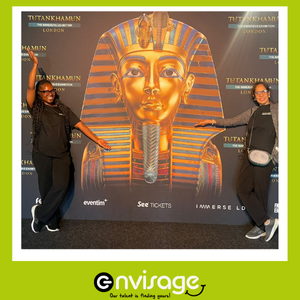
If a visitor enters a carefully created immersive space and the first staff interaction feels abrupt or purely transactional, some of the atmosphere can disappear immediately. This is particularly clear in large-scale immersive exhibitions, where visitors encounter staff at several points throughout the journey, welcomed at the entrance, directed towards interactive areas and helped with questions as they progress, and each of those moments needs to feel connected to the last.
That does not mean every member of staff needs to become a performer or remain in character, but the tone, energy and language should still support the environment, because even a twenty-second conversation about where to go next forms part of the visitor’s impression of the whole experience.
Exhibition Branding Depends on the People Working the Stand
Trade shows create a slightly different challenge because the environment is usually more commercially focused. Companies may invest heavily in exhibition graphics and stand design, particularly at major venues such as the NEC or ExCeL London, where visitors are surrounded by hundreds of competing messages, and while the stand may attract the first glance, it is the people working there who determine what happens next.
Someone may pause because they recognise the brand or simply see something interesting happening, and at that point a member of staff needs to decide how to engage them without making the interaction feel forced. Approaching too aggressively can push a visitor away, while ignoring them can lose the opportunity entirely, so good exhibition engagement sits somewhere in between, where the visitor feels noticed without feeling trapped in a sales pitch. That is where experienced staff add real value, because they can read the situation and bring the right person into the conversation when needed.
Technology Should Enhance the Experience
Technology has become a major part of exhibitions and experiential campaigns. Interactive screens, virtual reality, digital games and personalised content can all create interest, but technology alone does not automatically create engagement, and visitors still need a reason to use it.
A member of staff can introduce the activity and encourage people who might otherwise walk past because they are unsure what they are supposed to do, which is particularly important with unfamiliar technology. A visitor who does not understand an interactive display may feel awkward asking for help, whereas an approachable member of staff can remove that barrier instantly, and technology tends to work best when it supports the human experience rather than replacing it.
Avoid Over-Scripting Brand Interactions
One of the most common mistakes in experiential marketing is trying to control the conversation too tightly. Companies naturally want key messages delivered accurately, but visitors can tell when somebody is repeating memorised lines, and that recognition tends to work against the brand rather than for it.
A better approach is to give staff clear talking points, explain the purpose behind them and allow conversations to develop naturally, because people ask different questions and have different levels of interest. Some visitors want a detailed explanation, while others would rather browse quietly, and some care about price while others are more interested in practical use. Good experiential staff can adapt without losing sight of the core brand message, and that ability to react to another person is one of the greatest strengths of live marketing over other forms of advertising.
Think About the Whole Visitor Journey
Brand consistency should not stop at the main attraction or exhibition stand. Companies need to consider every moment where a visitor encounters someone representing the business, from registration or arrival through to queueing, product interaction and eventual lead capture or departure.
A strong product demonstration can lose some of its impact if the visitor has just spent twenty minutes in a confusing queue with nobody available to explain what is happening, and a positive experience can just as easily be undermined by a poor final interaction. Experiential staffing works best when everybody understands how their own role connects to the wider journey, so the person greeting visitors knows what happens next, and the person supporting an activity understands where somebody should go afterwards.
Measure More Than Just Footfall
If experiential staffing forms part of the marketing strategy, companies also need to think about what success actually looks like, and footfall alone only tells you how many people arrived. Better measures might include qualified conversations, samples placed with the right audience, leads generated or appointments arranged, and staff feedback can be just as useful, because the people speaking directly to visitors hear questions and comments that never appear on an analytics dashboard. That information can improve future campaigns as well as inform wider marketing decisions.
Bringing Event Branding to Life Means Making It Human
Strong event branding still needs good creative thinking, consistent visuals and a clear message, but those elements are only part of what visitors remember, because the moment somebody speaks to a person representing your business, the brand becomes human, and that interaction can reinforce everything your marketing has promised or quietly contradict it.
For companies planning exhibitions, immersive experiences and product launches, the question should go beyond whether the event looks on brand, and should instead ask whether it sounds like your brand and makes visitors feel the way it should. When the environment, the message and the people all work together, event branding stops being something visitors simply see around them and becomes something they genuinely experience.
Related Posts